Set a Video Generation Attempt Budget Before You Start
An attempt limit helps you decide when to generate, edit or change the method. Build the plan from current tool costs and the number of usable shots you need, without assuming that every generated second will survive the edit.
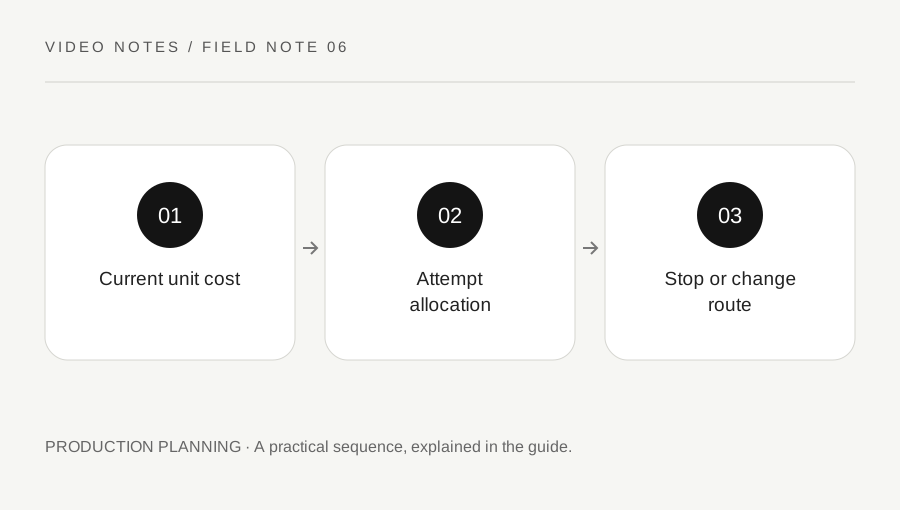
Original explanatory diagram. Examples illustrate a method or decision; they are not claims of personal testing.
Define the usable result first
List the shots the edit actually needs and the acceptance conditions for each one. A decorative background and a factual product interaction have different tolerances. State the intended duration, framing and essential action. Do not begin with a large credit balance and then invent enough shots to spend it.
For an illustrative three-shot edit, one shot may be a simple abstract transition while another must preserve an approved object accurately. Assign attention according to those requirements. The aim is to plan a finished edit, not a folder containing the maximum possible number of generations. Include conventional editing and real footage as valid alternatives from the start.
Check current cost for the exact operation
Read the provider’s current usage information and the cost displayed for the selected model, duration and output settings. Adobe explains that generative credit consumption can depend on the feature, model and output. A rate remembered from a different model or an earlier plan may be wrong. Do not use an old comparison chart as a purchase guarantee.
Record the unit being charged: per generation, per second or another stated measure. Check your actual account access and renewal information separately from the general product page. Avoid assuming failed generations, previews or edits always have the same credit treatment. Use the provider’s current guidance for those cases before making a plan around free retries.
Allocate attempts with a reserve
Choose a small initial attempt allocation per shot and keep some capacity uncommitted. The reserve can address a newly discovered problem rather than being spent automatically. In an illustrative plan, you might compare two candidates for a simple shot before deciding whether another attempt would answer a specific unresolved question. These numbers are examples, not measured success rates.
Keep production time in the same plan. Generation waiting, review, download and editing can consume more attention than the prompt itself. A technically affordable batch may still be impractical before the deadline. Record both the credit budget and the review time you are willing to spend, with a clear point for reassessment.
Use a reason for every retry
After each attempt, identify one consequential issue and choose a change that addresses it. If the composition is wrong, alter composition guidance; if the action is too complex, simplify the action. Avoid changing every setting at once and then claiming you know why the result improved. Keep the accepted and rejected candidates labelled.
Compare a retry with an edit or another production method. A clip with a useful middle section may only need trimming, while an inaccurate product shape may require a real asset rather than more prompting. Do not keep generating solely because earlier attempts already consumed resources. That past cost does not establish that the next attempt is the best use of the remaining budget.
Close the budget with honest observations
At the stop point, count usable shots and record the actual cost and review effort from your own session. Separate facts from estimates. A result from one brief does not establish a general model success rate, and a lucky first attempt does not justify promising the same turnaround to a client.
If the edit is incomplete, choose a revised scope or another method before spending more. For future work, use your notes to improve the acceptance conditions and input preparation. Recheck current provider rates whenever the model or plan changes. A small attempt budget is a decision tool that keeps production deliberate; it is not a formula guaranteeing a finished video at a fixed cost.
A practical checklist
Choices are saved in this browser. Reset them here or clear this site’s browser storage.
Questions that come up
Can I calculate a fixed cost per finished second?
You can estimate for a particular plan, but rejected outputs and editing needs vary. Do not present generated duration as finished usable duration.
Are all retries free?
No universal rule applies. Check the current provider’s terms and displayed usage information.
Should I use every remaining credit?
Only if another attempt serves the project. Unused capacity is preferable to generating without a clear decision purpose.
References & scope
Background references checked on 18 October 2026. Worked examples and diagrams are original teaching material.